


Suppose you’re watching basketball and your team forces two turnovers, scores 7 quick points, then sends the opponent into a timeout. If you check online, you’ll likely see that the live odds have already moved based on the changing game state. Seeing the odds change in real time can create the feeling that you need to act immediately or risk missing the moment, especially if you think your team is going to continue pressing their advantage. Before you do so, however, it’s better to pause for a moment and check whether the last sequence really changed the direction of the entire game or merely nudged the score a little. A timeout offers a chance to separate those ideas.
That extra thinking time matters because speed changes what people notice. A 2025 study of basketball decision-making found that time pressure reduced accuracy in video-based play decisions, with a larger decline among novice players than experienced ones. The participants were athletes choosing between actions such as passing, driving, or shooting, not people placing live bets, but the result illustrates a useful limitation: urgency compresses visual search and makes it harder to weigh competing cues. A pause gives the viewer room to restore that missing context.
What to Do During the Break
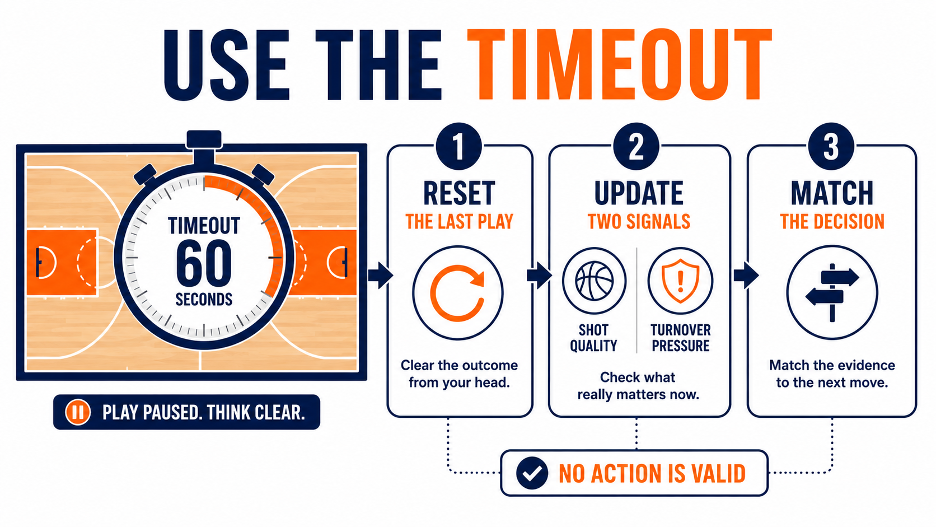
Treat the pause as a short sequence with three jobs. Reset the story created by the last play, update only the information that actually changed, then match that change to a relevant time horizon.
Suppose the run began with a contested 3-pointer, followed by a bad inbound pass and a fast-break layup. One place to apply the sequence is Lucky Rebel, a sportsbook-and-casino website that includes a Live area and in-play betting on games already underway. Start by comparing the current position with the pregame view. Was the trailing team already expected to struggle against pressure, or did one careless possession create the entire swing?
Next, update two signals connected to what happened. Shot quality and turnover pressure are good choices for this, while less precise aspects, such as crowd noise or your sense of confidence, should not be treated as strong evidence here.
Finally, look at the available live market and ask whether its time horizon matches the evidence. A next-score or quarter market, when displayed, is more closely tied to a short burst than a full-game conclusion. The Live sports area associated with Lucky Rebel supplies the concrete setting, but the reasoning remains the same on any live board: your decisions should correspond to the change you can describe, rather than the emotion produced by the scoreboard.
The same method extends beyond basketball. This cross-sport discussion of natural breaks identifies timeouts, commercial breaks, quarter breaks, tennis changeovers, hockey intermissions, and halftime as moments when viewers can reassess. The useful questions are: what information became available during the previous passage of play, and which part of the contest can that information reasonably affect?
Reset the Last Play
Resetting does not mean ignoring what just happened. It means refusing to let one dramatic event rewrite every earlier assumption. Return to the baseline you had before the game: expected pace, matchup advantages, likely lineups, and any condition that shaped the original read. Then ask which part of that baseline has been contradicted.
In the basketball example, a single poor inbound pass does not prove that the defense has found a repeatable weakness. A second forced turnover, a changed press, or repeated difficulty advancing the ball would carry more weight. The timeout helps because coaches may alter personnel or spacing, letting the team answer the pressure. That response is new evidence too. A run that disappears after one adjustment is different from a problem that survives it.
Update Only What Changed
The update stage should stay narrow. If the run came from turnovers, examine ball security and defensive pressure. If it came from open shots, examine how those shots were created. Avoid collecting unrelated statistics simply because the pause allows more screen time. Extra information can make a decision feel researched without making it more relevant.
This is also where the “no action” outcome earns its place. The available market may concern the whole game while the evidence concerns only the next few possessions. The odds may also move far enough that the original question is no longer the one being offered. Waiting for a better match between the evidence and the market is different from waiting for a guaranteed price.
Match the Decision to the Evidence
The final step is to name the claim before acting. “Their press is creating repeated rushed possessions” is specific. “They have momentum” is not. A specific claim tells you what would confirm it, what would weaken it, and which time horizon might be relevant.
Time pressure can also make people repeat a familiar choice, rather than reconsider uncertainty. A Scientific Reports experiment found that participants under limited decision time became less guided by value and more likely to repeat previous choices. This may explain why urgency can pull someone back toward the last opinion, especially after a vivid play.
The best time to place a live bet is the point when the latest event has been translated into a clear, limited claim, the available market matches that claim, and the decision still makes sense after the emotional force of the last play has faded.